Walls in Ebenalp
Interpreting kinesis, vacuum, void and matrix in a Palaeolithic context

By Agnes Horvath
What is a wall and what is a container? A wall is the border of the receptacle, that carries a substance, whether liquid or solid ones. Even the void itself could be accommodated between the container’s walls. If the receptacle happens to be closed by a lid or so, hermetically (note the name Hermes and the Alchemical implication in the word ‘hermetically’), then by sealing a vacuum, tension occurs inside, which could be released or solved by an opening, whatever kind is it. Further on, the tension could be divided by rows and columns, where every division itself is a duplication, and thus the matrix is born, the copying, impressing instrument of new creation (concerning the matrix, see my Political Alchemy, Routledge, 2021). This square base of circular elements is used to generate one thing from another, familiar for us since the discovery of the placeholder, circular, 0, zero, or in another context: the void.
This simple math was functioning in Palaeolithic caves, made to function by their visitors, traced back to the Neanderthals, 120,000 years back in time, or even before. Three Palaeolithic caves in Canton St Gallen in Switzerland – Wildkirchli (Wild Chapel), Wildenmannlisloch (Wild Man’s Hole) and Drachenloch (Dragon Hole) – are remarkable examples of this vacuum-utilising, square-container-matrixing practice, where aggrandizement through transformation was practiced, in the form of mime, copying, impressed imitation. Such mime plays were designed to receive impressions of bear types, as is discussed in ethnographic works, like in Roslyn M. Frank, ‘A Comparative Study of Basque and Sardinian Ursine Carnival Performances’, Insula-3 published in June 2008, and which to a certain extent also can be still seen in the various Silvesterchläuse wild men figures during the Neuer Silvester celebrations, still practiced in Urnach, St. Gallen canton, Switzerland, on 31 December – to our surprise, as we noticed just a few weeks ago.
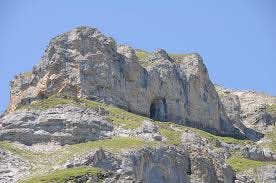
Drachenlock (Dragonhole) is a cave in limestone layers, containing a large bed of bear bones, 53,000-year-old charcoal remains and a bone flute, indicating an early appearance of humans in matrixing activity, which is the topic of this analysis. They utilised the bones of Ursus spelaeus, named as such in Bavaria, Germany, by the paleontologist J. Esper, in 1774. Bears came to the cave for hibernation and occasionally died during this, or came to the cave to die. This cemetery of cave bears is not the only such graveyard, but a huge number of caves all over Europe contain massive remains of cave bears, from Spain to Georgia. In Drachenloch stone chests and low walls were found as well, that had been built from limestone slabs near a cave wall with bear skulls inside them. Such a horizontal-vertical alternating chessboard pattern repeats itself outside the cave, on the mountain range itself, with the horizontal drywall system that serpentines its vertical walls from the rich water sources up to the mountain top of Vättis in the Valley of Tamina, which has thermal waters from the Tamina Gorge, river Tamina, flowing towards the Rhine.
In the cave several square constructions appear, one of which contains several bear skulls, which are oriented to the exit of the cave. The same pattern was unearthed (a much earlier construction) in Regourdou, southern France recently. A rectangular pit contained the remains of at least twenty bears, covered by a massive stone slab. These returning square motifs somehow resemble the ‘wheat and the chessboard’ puzzle, with one gain of wheat placed on the first square of the board, two on the next, which then continue doubling as you go, where you would exceed the number of grains produced in the world annually long before reaching the last square. This is why a methodical usage of the chess game’s 64 squares, with two alternating colours and the aggrandized wheat-grains would be able to solve starvation on a mass scale by the mass product it results in. In other words, any such pattern of identical squares conveys the idea of open-ended replication, a matrix inducing transformative growth. The only thing which is missing is the kinetic energy that makes grains move from one square to the next, which was allegedly discovered in the caves. Similarly, the 25,000-years-old upper Palaeolithic Brassempouy hairdo has a checker-board-like pattern, also representing the matrix – to my knowledge, this was noticed for the first time in Modernity and Charisma (Palgrave, 2013).
The felt similarity between the cave bears and themselves is shown in the Neanderthal burial in a similar stone pit (with covering lid) adorned with bear humerus. Kinesis – and here we refer to its Ancient Greek meaning – is the motion of the soul or souls, whether living or dead: I mean whether it has a body or not, as in the case of the souls of the dead. The souls of the dead, in the Regardou cave through the souls of the dead bears, may have served in Palaeolithic rituals as the energy of moving things into transformative growth. The Ancient Greek notion of the soul (psyché) is dynamic, it is the principle of life, either when animating the body, making it move, or just as the souls of the dead, like in Homer’s shadowy afterlife. When the soul receives its body during birth, in this blessed moment the soul not only gives its vitality to the body but also the body’s particular, characteristic forms, too. However, all those souls who have lost their bodies (by death) are becoming accidental ones, those who are the souls of the dead, still with movement and change, but without possession. Their essence of kinetic dynamism is infinite and always in eager search for bodies. The ancient humankind that climbed up occasionally into the cave, at the height of 2445 metres, or to the two other caves nearby, sought to activate the souls of the dead using particular noises, colours, temperature, helped by songs, by the red heat of the fire, and by rubbing the edges of bear bones. Thus, evoking the souls of dead bears meant penetrating into their world by means of intrusions (about this, see the finding in the Dragonhole cave of a cave bear skull with a femur bone from another bear stuck inside it), or disturbances, though still within the borders of decency and good will.
Only much later, in the period of degeneration (and also with other kind of people, the Cro Magnon, as Homo sapiens incurred violence and harm against their dead) we can see how hurt was committed against bears, as shown on the wounded bear depiction from the Les Trois Frères cave, Ariège. In this image a 60 cm large bear is
depicted as wounded and vomiting blood, discussed in Political Alchemy. A similar image, with the purpose of causing harm to a bear, can be seen in the Palaeolithic Basura cave, Toirano, Savona, Italy, with clay balls picked up from the ground and thrown on the image of the bear on the cave wall.
While kinetic energy is not simply physical motion, but life-force, breath, or animating principle, it is the growth, respiration, mind or thought that is separated at death into a weak, shadowy effigy, losing its vitality. Even when the body becomes inert, it remains subject to evoking practices. We see here how the form is an actuality for the body as claimed by Aristotle; the soul is the body’s potentiality, the source of the body’s inseparable meaning, the body’s principle of life. The soul is the motion of the body, and the soul functions within the body itself. This ceases to be an active principle when life becomes low and base, when it is turned into shadow. Yet, the living souls share with the souls of the dead the passive abilities for kinetic energy, which is still sufficient for the mental manipulation of things, for generating power or controlling physical systems or complex forces if only it found a body. In this conditional way, and including also the modern variety, the kino/ kinesis/ cinema can influence the mind of its watchers, or in various other ways these images sense and understand the will of their activators, so are a sort of quasi objects, which raised Serres’ interest. Michel Serres developed the term in his classic book The Parasite (1982). According to Serres quasi objects aren’t purely natural or social but exist as relational nodes, mediating between subjects and objects, forming collective practices, and revealing hidden structures.
In our case, this is exactly what had happened, when the large numbers of bear skulls were arranged into piles and their skeletons were carefully laid out in layers, side by side or superimposed. Many of the bear fibulas stored on top of a slab of rock were broken, but their broken ends all faced one direction. Neat and ordered arrangements maintained by small slabs of stone around a bear’s skull all precisely followed the outline of the skull. The few holes pierced on skulls are the escape holes of the souls of the dead, trapped in the skull. A similar though not identical case are the kill holes in ceramics, found in the Maya Actun Tunichil Muknal Cave, made to release the spirit or life force of the object deposited in burials or caves for the afterlife. Here and in several other cases the souls of the dead were evoked by various manipulations and were directed into living bodies. These holes were facilitating the flow of kinetic energies to vitalize things or images of things. Images were built up in this way in a careful and knowledgeable manner. Concerning images, the research of the German art historian and anthropologist Aby Warburg is of special importance. Warburg arranged in his Mnemosyne Atlas images with several meanings in such a way that various significant connections of meanings could be realised between the images.
These men practically had no weapons, apart from small flakes of stone. They had neither spears, nor arrows or axes. In Drachenloch cave, they worked with their two hands, erecting walls, paving the floor and arranging the skeletal remains of the bears. They worked hard to rub them until the bones became smooth from the rhythm-making movement of polishing, cleaning, drying them to strengthen their high level of kinetic transformation. Robert Bednarik offers an interesting description of a similar process practices on rock formations that triggered metamorphosis in his article ‘Rock Metamorphosis by Kinetic Energy’, published in Emerging Science Journal, vol. 3, No. 5, October 2019, p.293. Grinding stones are also used for magical activities in the prehistoric cave dwellings of the Tassili plateau, Algeria, North Africa, Tassili N’Ajjer National Park. In general, there is a belief concerning the magical transformation of elements into different compositions, where grinding stones create wealth, abundance, new metamorphic creatures. To some extent this also might apply for working on the bones. Such shaping of the surface of skeletal joint sockets, which is encountered when another body is moved in contact with them, is the typical phenomenon of grinding friction, so well-known in cultic activities. The cuts on the surface of the bones evoked the souls of the dead, just like the exposition of the skull and marrowbones were projecting the living souls to the dead, thus stimulating their awakening.
A slightly different issue is the usage of the lower jaw of the bears: almost all the unbroken cave bear skulls lacked a lower jaw. Could it be that the resemblance between humans and the bear finished here, with the lower jaw? The upper jaws are easy to homologise among different types of animals, as Goethe’s intermaxillary bone demonstrates (the intermaxillary is a pair of cranial bones that are located at the front of the upper jaw, sustaining the incisors in all those animals that have these teeth, including bears and humans), but not the lower jaw! The unfused mandible of the bear is different from the human. Humans have a single, fused bone and a protruding chin. Thus, perhaps the bear mandible was removed for another purpose, that of growth, as by manifesting human images on it they could duplicate the acceleration of the evocation of the souls of the dead bears, thus, to promote growth by conception.
Incidentally, the lower jaw in Hungarian is called áll, while the identical word as a verb means ‘stand’. Could it be that the lower jaw has this highest meaning for a Palaeolithic mindset too? In comparison, there is another Hungarian word, nő, which as a noun means ‘woman’, while as a verb ‘grow’, the two having evident links; but the same game can be played with fog: ‘tooth’ as a name, ‘hold or catch’ but also ‘conceive’, as a verb – which might even be relevant here, as the lower jaw of course contains teeth, and growth and the idea of conception are closely connected in nature. Two such lower jaws were found in Wildenmannlisloch, used for carving figurative images onto them, resembling human ghosts, effigies of a wild spirit, more than Venus figurines as the discoverers called them. These small, uncertain quasi-forms, unsignificant but frightening, 30 000 years later reappeared in cave drawings.
This evocation of the souls of the dead (which remain for a given time period and then depart) and their canalisation between walls requires a strict cooperation of a handful of operators. All three caves are within the range of the Santis mountain, and all three have a North-East orientation. They aimed at the utilisation of the kinetic energy of the souls of the dead. They succeeded in making the contact, the link between themselves and the bears (in Regourdou the Neanderthal tomb with a pavement of flat stones is connected to the bears: below and above the body of the deceased were the tibias and the humerus of bears), at least 80 000 years ago. Here the bear is a man masquerading as a bear, and thus the bear is an intermediary between man and the souls of the dead bears. This substitution is necessary: it seems to be that the souls of the dead cannot enter into the forms, only into their substitutions, into their quasi forms. This helps to understand the practice of sacrificial rituals, which is always the sacrifice of others, which can be always substituted. Self-sacrifice has a completely different connotation.
But why such search for connections, if the Neanderthal, as by now generally accepted by cultural, genetic and morphological evidence, had language competence, high brain capacities, elaborated and mindful customs? This is discussed extensively in various works by Marylène Patou-Mathis. So why did they bother with the complicated issues of substituting themselves with the bears and harvesting the souls of their dead? What was their scope of interest? It seems probable that they had a calculated gesture toward that exalted and timeless power, which was not theirs, to gain extra profit from it, and trying to utilize its strength for their own purposes.
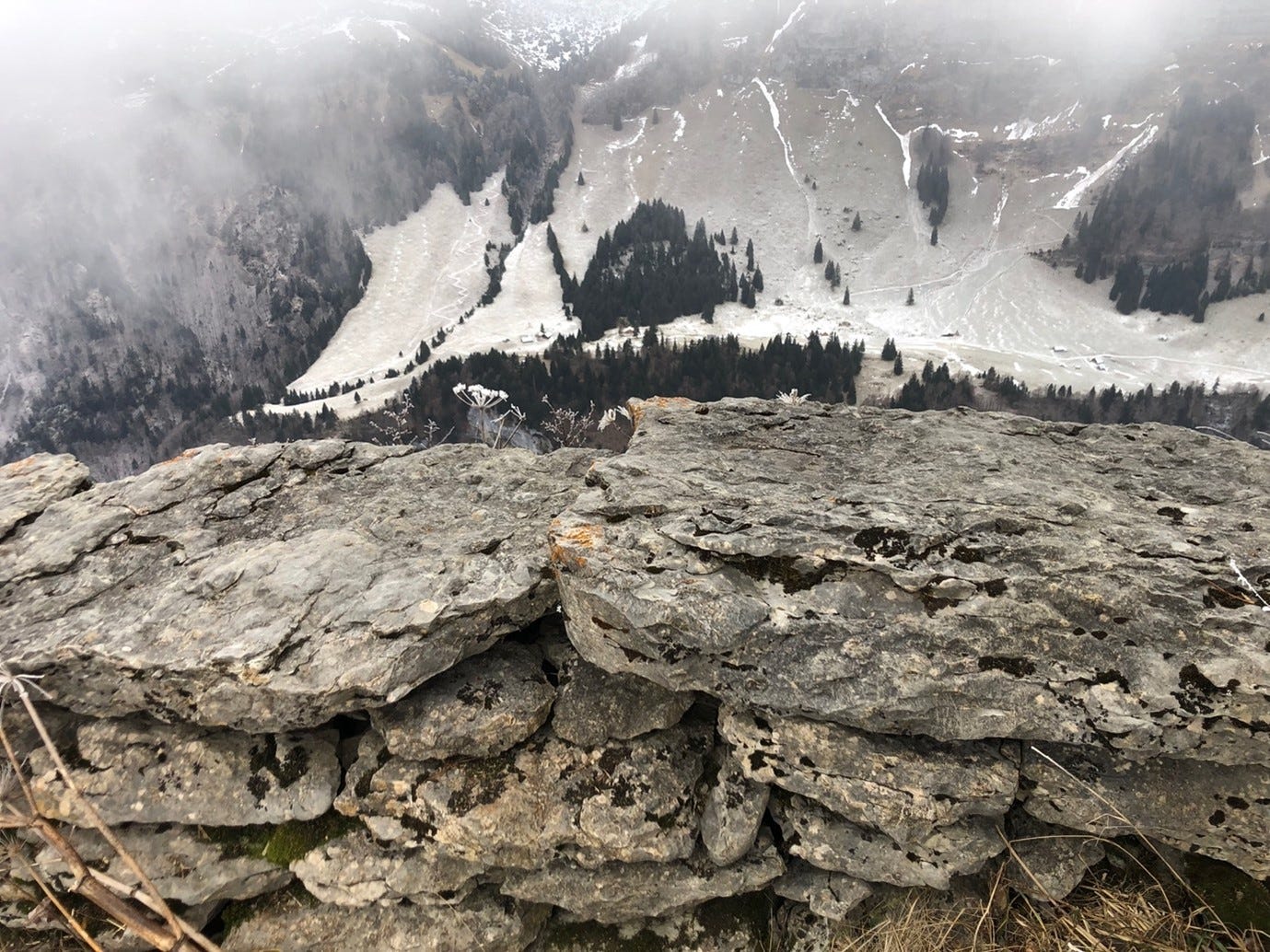
Therefore, nothing remains for us other than collecting the extraordinary remains in front of our eyes, and from these facts interpreting their interest in the bear bones. What else could be the significance of the stone walls structures (see the picture from Ebenalp, in the year of 2025, in Christmas time, at the height of 1700 metres, showing a surreal walling system, high up in the mountains, near a rift), erected not by them but by this exalted and timeless kinetic power, that moves stones into walls after a given design provided by the image of rhombic crystal systems, in a most natural affinity with the transcendental power of the souls of the dead.
Turning back to matrices, in the cave of Bruniquel in Southern France, another square stone structure has been discovered, deep in the cave of stalagmite and stalactite. On a four-by-five metre rectangular square stone masonry base a centre-based construction was erected, from pieces of columns of stalagmite and stalactite, and not even the bear-bones are missing, though in burnt condition. This in Bruniquel is a Neanderthal piece of work, on the manner of presumably imitating body-centred crystal systems, like the rhombic crystal one, the marcasite which was found in the cave of Drachenloch. One half of a ball of marcasite geode from the cave of Drachenloch, exposed in the Ethnography Museum of St Gallen, shows its cracked opening with all the crystal lines pointing into the centre, a similar figuration than the one in Bruniquel cave. With one difference: while both marcasite and stalagmite react for humidity, this reaction is odourless for the second, while the first reacts by releasing sulfuric acid. The stench of sulfuric acid is the marker of disease and decay, making sulfuric a sensory marker for the souls of the dead, and its smell later became a marker to signify evil, demonic presence, and hellish environments.
Matrixing, or utilizing an artificial matrix by operating with rows and columns, rebuilding squares for matrices of bear bones, which have already a readymade substitution with man (seen in the cave of Regourdou), imitating crystal structures in order to evoke the souls of the dead for release, and channelling kinetic energy for the purpose of erecting walls, which serves as an artificial barrier for keeping the soul fluidity in situ, in containers for further use, when the vacuum is ready to be released for creation, was not a small job for men in a 46,000 years distance. But seemingly, they have performed it.