Envisioning Our Present
An Introduction to Sándor Márai’s The Offended (1946)

By Arpad Szakolczai
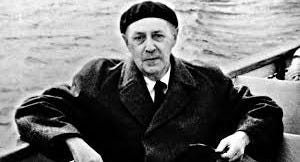
The Hungarian writer and poet Sándor Márai (1900-1989) had an astonishing life, produced an astonishing work, which had an astonishing reception history, and has an astonishing contemporary relevance.
Each of these claims must be individually substantiated, at least briefly, before I proceed to a more detailed discussion of Márai’s most significant work, The Offended (1946), which will be topic of a future post
Life
Márai (born 1900; died 1989) lived through the tumultuous 20th century almost in its whole length, starting literally from its “zero” year, which also means that his adolescence, with almost mathematical precision, coincided with the years of WWI – thus making his personal “rite of passage” coincide with the utterly liminal years of the Great War, which radically altered Europe, and by extension the whole world. It was out of the wholesale destruction produced by the war that the entire contemporary world was brought forth. His closest contemporary in this sense was Eric Voegelin (1901-1985), and so it is not accidental that the ideas of both have such a striking relevance for our days.
At the end of the War, like so many of his generation, Márai had quite socialist views, even played some minor role in the 1919 pro-Bolshevik regime in Hungary, so his father arranged him to study in Germany during his university years. He spent years there, and then even longer years in Paris, interspersed with visits to Italy, especially Florence, and even Damascus, so gaining a quite comprehensive overview of the state of the post-war world. During this time, he spent little energy on formal schooling, but was rather observing and writing, mostly as a journalist, though also making his first experiments with poetry, novel-writing and play-writing. In 1926 he returned to Hungary and decided that he must stay there and write in Hungarian only, whatever it took; and soon became a very popular and critically successful writer, in this sense the leader of his generation, also being elected to the Hungarian Academy, which was a very rare feat for a writer.
Politically, he increasingly gave up his youthful leftist ideas, and defined himself, already in his famous 1934 quasi-autobiography, as a “polgár”, a Hungarian word derived from German burger – for a long time most city-dwellers were German in Hungary, in fact even Márai had German origins (the name of his father was Grosschmid, though the family since quite some time became “Hungarianised”). Márai reclaimed the meaning of this word, depreciated through Marx’s much misdirected criticism of the bourgeoisie, and focusing on its cultural sense, close to the classical meaning of Bildungsbürgertum, for example as represented, at least for a time, by Thomas Mann, but by no means coinciding with it. He therefore was unreservedly hostile both to the Nazis and all kinds of fascism, and the Bolsheviks and all kinds of communism.
After WWII, he quickly perceived that instead of a return to normality, of which he had little hopes even at the start of the war, the communists would gain a dominant role in Hungary, helped by the Red Army. He finished his great epic novel, The Garrens, and started to publish the third volume, in three books, in 1947, but the second volume, to be published in 1948, was destroyed while being printed at the press, while the third volume was not printed and published until 1988.
In 1948, and during the last months if not days when it was still possible, Márai left Hungary, never to return. He vowed that he would never return to Hungary while a single Russian soldier remained there, with the Communists in power, and held to his decision. He also prohibited the publication or staging of any of his books or plays; when in the 1980s, with the softening of the regime, his devotees tried to stage illegally a play of his, he prohibited this on his own part in no uncertain terms.
After 1948, Márai kept writing and publishing his diary, which was quite widely read, and is a most precious document, and wrote poetry, especially connected to special historical-political occasions, but hardly wrote novels or plays. He said he could only write in Hungarian, and outside Hungary, being a stranger in a strange land, could not gain the inspiration to continue his oeuvre. In the mid-1980s, when he was well into his 80s, in quick succession he lost all his siblings, his stepson (his only son was born and died in 1939, having lived only for a few weeks), and his wife. Remaining completely alone, hardly being able to walk or to see, he took his own life in February 1989, so just before the collapse of Communism – an act for which he was preparing, should it become necessary, for years.
Work
A good part of the stunning character of Márai’s work has already been indicated in the short account of his life. Márai primarily was a novel-writer, and within hardly more than a decade published a series of novels that established him as not just the most significant Hungarian novelist of the century, but a major European writer of the 20th century, often compared to Thomas Mann and Hermann Hesse. At the same time, he was a very successful playwright – not many of even the best novelists managed to pull off this feat; and even an acknowledged poet. His poetry, even if not up to the lyric genius of the greatest Hungarian poets of the age, Endre Ady, Attila József, or Dezso Kosztolányi, had a very particular force, which came out best in his most famous poems, inspired by the political situation: “Halotti beszéd” (Funeral Oration), written in 1951, about Hungary under Communist rule and his exile experience, and Mennyből az angyal (Angel from Heaven), in 1956, about the anti-Soviet popular uprising.
But Márai’s work was astonishing not only due to its artistic qualities, but also due to its seismographic character. Based on his innate sensitivity and quite unique life experiences he was able to perceive or intuit whatever was in the air, the heart and depth of whatever was going on, and express it through novelistic personalities. This is also the reason, again returning to the story of his life as told briefly above, that he could not continue this work in emigration or exile. He could not enter the “heart” of the United States, or even Italy, where he had to spend the second part of his life, only writing about them from the outside.
Reception
The reception of his work is again a saga on its own. In the 1930s he became very popular in Hungary, and his novels were also translated around Europe, especially in German. This continued during WWII and shortly after, as far as it could, but with the Communist takeover and his emigration his work was increasingly surrounded by silence. How could a Hungarian writer, living in exile, and writing still in Hungarian, have his voice heard? And then, suddenly, literally at the start of the new century goddess Fortuna changed her mind and – especially through Roberto Calasso, who in 2000, during a night in a hotel in Paris, read the French edition of Embers, obtained the publication rights of the book next day, and started to publish Márai systematically in his Adelphi publishing house – he became popular all around Europe, especially in Italy and Spain, and even around the world.
This popularity is not easy to explain by the standard market, academic, and even intellectual logic. Márai’s most popular novels were written in Hungary, about Hungary and Hungarians, in the 1930s and the early WWII years; how could this be so important, in the 21st century, all around the world? It is to be noted that Hungarian intellectuals, and the culture in general, is almost ashamed about this fame, considering Márai as just a “bourgeoise” writer, whose sudden popularity is only due to some kind of nostalgia for the good old days – that never were.
This, however, is all wrong, as it fails to penetrate the core of the resounding contemporary relevance of Márai’s work and ideas.
Contemporary relevance
The sudden discovery, in the 21st century, of the novels of a Hungarian writer, written in Hungarian, and a good 70-80 years ago, certainly requires explanation. Understanding can only come from reversing the terms, and arguing that the presumed liabilities – old, Hungarian novels – could be turned into assets. This will be done by using the terminology of International Political Anthropology, especially liminality.
The first point concerns the potential status – cultural, socio-political, geographic – of Hungary. Hungary is certainly a marginal European country, by standard measures. It is small – though, with its about 10 million inhabitants inside the current frontiers, and a further several million Hungarians outside, after all it is not that small: many established European countries have no more than 4-5 million inhabitants. It is also very isolated, by its language, which is not Indo-European and is both geographically and linguistically very distant from the other non Indo-European languages. However, as is recognised in Political Anthropology, marginality can be turned into liminality – and in several respects, concerning time and place, just as other characteristics, Hungary since a long time is in quite a liminal position.
As discussed particularly well in a classic book by Béla Hamvas, Five Geniuses, Hungary is situated between both the North and the South, and the West and the East of Europe, taking up aspects of each, while having a specific cultural profile on its own. Such an in-between situation rendered the country vulnerable in many senses, as shown by both the Mongolian invasion in the 13th century, the Turkish occupation in the 16-17th centuries, and the long-standing fights, of various kind, against the Germans and the Austrians on the West, and the Russians on the East. However, it also generated a certain spirit of resistance inside the country, shown both by the 1956 popular uprising against the Soviet occupation – no other Soviet satellite country produced such a fierce anti-Soviet resistance – or, in a different though somewhat connected and not irrelevant manner, in the all-time Summer Olympics medal table. Here, Hungary is on the 9th place in the world, way ahead of all countries of similar size, just behind Japan and Australia, and way ahead of larger countries like the Netherlands or Poland. In fact, in 1936 and 1952, Hungary was third in the medal table (in between, there were no games in which Hungary could participate), while it was 4th in 1968.
In terms of cultural achievements, the language barrier for Hungarian was enormous. It was this barrier which now Márai somehow managed to overcome by achieving international recognition. But what was so special in his books?
Here we need to turn to another liability, the considerable time that had passed since they were written and published. Márai’s novels vividly capture a world that was undermined by WWI and definitely destroyed by WWII, but which was pretty much alive until then – there, in Hungary, much more than in the Western European countries, where modern destruction made much stronger inroads already before.
In itself, this could justify the nostalgic interpretation of his success – people, at least some people, now read Márai because it evokes for them the good old days. However, this is simply not true: Márai’s books certainly do not present the pre-war past as ‘the good old days’, though neither do they interpret its passing as signifying ‘progress’, in any meaningful sense. They were rather written by somebody who, due to the incidents and coincidences of his life history, took up a perfect threshold position, and from this position, being aware of how people lived before, especially in his own town which then belonged to Hungary, and of what happened in the two World Wars, and especially what happened between them, and possessing a uniquely sensitive and intact mind and soul, not leaning toward any ideological-activist position, managed to offer such a comprehensive and penetrating vision of the character of the changes that it is only now that we can understand its width and depth – which was so great that his insights have quite unique relevance for our very present.
However, it is exactly here that a further complication appears – a further reason for this blog, and its follow-ups. Márai considered as his most important work the novel cycle The Garrens, the last work he wrote and published in Hungary, before leaving the country in 1948. This three-volume six-part book has a very complex history and structure. It first book is the novel Rebels, published in 1930. This novel, about a group of adolescents living just before WWI, and rebelling against the world of adults that was already collapsing – analysed so well by Tom Boland in International Political Anthropology (2018, no.1, pp. 29-41) – at that time was a stand-alone book, and is by now translated into many languages. It was this novel that established Márai’s fame – he was 30 at that time – in Hungary. Some years later he had the idea of writing a follow-up, entitled The Jealous and published in 1937. It was a strange follow-up, as the Garren brothers, Péter and Tamás, did not play a major role in the first novel. However, in 1934 he published one of his most successful works, the autobiographical Confessions of a Citizen (‘polgár’), and this inspired him to make a semi-autobiographical character out of Péter Garren, and to offer a two-part extended family history, focusing on the return of the two brothers to their native city, left decades before, and meanwhile becoming occupied by a foreign army, on the occasion of their father’s illness and passing away.
It was after the publication of this novel that the Anschluss came, on 12 March 1938, which for a series of reasons was a traumatic moment of reckoning for Márai. It was after this historical event, and the ensuing reckoning, that Márai’s greatest, best-known novels were written, one after the other: Esther’s Inheritance (1939), Casanova in Bolzano (1940), Portraits of a Marriage (1941), and especially, most famous of all, Embers (1942). The continuation of The Garrens was thus put aside – but not forgotten. In fact, from 1941 Márai returned to completing the cycle, and while at the same time he wrote and published several other novels, poems, essays, and also plays, the most famous being the 1942 Citizens of Kassa, the centre of his attention was devoted to the completion of The Garrens, his masterwork.
He completed this third volume, entitled The Offended, in three parts, in 1946, but decided to publish them as separate books, running with the time, as the Communist takeover was increasingly imminent. The first of these was published in 1947, entitled The Offended 1: The Voice. The second was printed in 1948, but was not published, rather destroyed while at the press, and only a few copies survived. The third remained in MS until 1988, when Márai’s publisher decided to publish all six parts of The Garrens together.
It is this three-part last segment, Part Two of the second volume as published in 1988 and reprinted later, and the two parts of the third volume, that indeed is the culmination of Márai’s work, and will be the sole subject of the following related blogs. Their significance, both as works of art, as historical documents, and as insights into the core of the modern world, is practically unparalleled. Yet, they have not yet been translated – except, as far as I can know, into Spanish – as the very peculiar structure of the work, its size, and its character as a Hungarian family novel, makes its publication difficult if not prohibitive.
The first part of this third book-volume – but let’s call it Volume Four – is indeed mostly about a voice: a very peculiar voice, the voice of Hitler, as the protagonist, Péter Garren heard it first in Paris, on the radio. It is an extended reflection on the character of this voice, its intolerable, frenzied screaming about intolerability. It also describes Péter Garren’s attendance of a party, with some choice hosts, one of them being a German officer whom he then visits, and who eventually turns out to be an personification of Eichmann. It also contains a mind-blowing description of a “Byzantine man”, and his significance, whom the protagonist encounters on his way to the party.
Volume Five, The Offended 2: Badge and Meaning (in original Jelvény and jelentés, a play with words, on the manifold derivates of the root jel “sign”), still has its focus on Nazism, and here the voice as if becomes incarnate, as Péter Garren attends a public speech of Hitler, and describes, in minute details, the shrewd and cunning techniques by which this cheap but talented actor managed to enchant not only his audience, but an entire nation. Apart from the description of the scenery, Márai offers a running commentary with phenomenological precision and depth, partly through the voice of a famous German writer, kept practically under house arrest, whom the protagonist visited. Altogether, this adds up to an inimitable analysis of modern nihilism, an assessment confirmed by the ending of the book, where Péter Garren sends a five-word telegram to his boss Emmanuel, who sent him to Germany: “Culture died. Stop. Nihil lives”.
The last volume The Offended 3: Epilogue: The rear guard, is directly inspired by historical events, but this is camouflaged in the narrative. In its, the native city of the Garrens, a port, is returned to Hungary, but the city lives this, for a series of good reasons, not as a liberation, but as a second occupation. This experience certainly has its historical roots, as the return of parts of Upper Hungary and Transylvania to Hungary in 1940 was due to Hitler, and the new Hungarian administration certainly did not respect local sensitivities. This set-up allowed Márai to formulate a comprehensive assessment of the utter failure and disaster of the modern world, formulated right after the end of WWII, the very same year when Auden delivered his Harvard Commencement Lecture. Márai was only 46 years old then, and lived for another 43 years, but this volume effectively turned out to be his conclusive words, written from a mental-spiritual height to which he could not gain access again, first in the years of the rising Communist power, and then in the long decades of exile. As one of the many bizarre twists of fate surrounding Márai, these were words he did not read again for about 42 years – as, according to the testimony of his published 1985-89 diary, he eventually fished the manuscript out of the bottom of an old suitcase only due to the sudden interest of the publisher.