


Janos Mark Szakolczai
Highly entertaining as it is, the 2023 independent film BlackBerry by Matt Johnson — chronicling the rise and fall of the “device everyone had before the iPhone” — leaves a lingering question: how did the iPhone actually manage to burst into the phone market with such a spectacular entry? The film’s protagonists — the real-life CEOs of BlackBerry, once the dominant force in the mobile industry — are portrayed as utterly baffled by the idea that anyone would ever want a phone without a tactile keyboard. The clicking feel and sound, they claimed, were at the heart of users’ enjoyment and desire to engage with these highly popular tools. Yet this belief proved self-limiting: today, there are virtually no smartphones with a full keyboard left on the market. How did that happen?
The Clicking Sound
The lure of the clicking sound is evidently something Apple understood very well. It was central to the “clickability” of the soft, (relaxing?), ant-like sounds that iPods — and later iPhones — integrated into their devices. These sounds gave users a subtle sense of audio feedback, a confirmation of engagement. This was quite common at the time, and no doubt it was important for users overall.
The physicality of actually having something to type upon was also key. When Steve Jobs gave his historical presentation for the first iPhone launch, he displayed a series of tools and devices that were already well established in the market — objects that everyone in the room most likely owned at least one of. He wouldn’t have chosen them otherwise.
That 2007 presentation became a central, world-changing moment. Jobs held up those familiar tools and declared, “We don’t need this. We don’t need these keyboards. You don’t need little pens and digital notepads, because all you need is your fingers.”
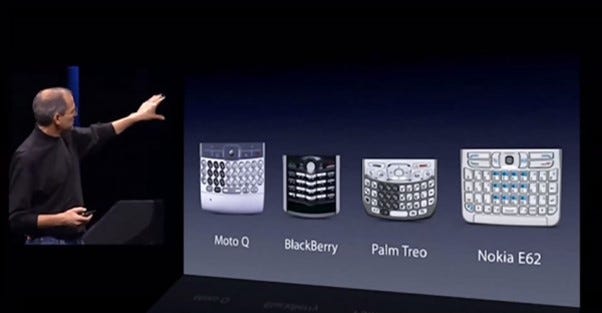
People bought that — quite literally and quite centrally. My interest is in understanding what exactly they bought into. Especially when we consider the film’s inside joke: why were people willing to pay that much money for this single device — the iPhone — which remains today arguably the most central, enjoyed, and used device overall? It is also, as Merchant (2018) notes, the most sold single device in human history –about 3 billion and counting.
The Peak of the Smartphone
My interest is not in whether iPhones in general are actually premium compared to the BlackBerry, Nokia, or whatnot, or in debating the relative advantages of Apple versus Android, etc., etc. Obviously, they are still among the top tier of devices that dominate the smartphone market. It’s interesting to note that when smartphones emerged, Apple devices became the epitome of what the iPod Touch already was: mobile, integrated with data, and thus something people could use to access the internet. That’s fine and wonderful, and something that has become central in smart device integration.
BlackBerry and other devices helped to usher in what became the age of hyperconnectivity — a period that marked the peak of their market presence through the mid-2010s. It’s an age we are still very much living in today, though it is arguably beginning to evolve into something else — perhaps through VR and AR technologies, which companies like Meta have been actively pursuing over the past few years – more of this later.
But to date, the new technologies have not yet replaced the iPhone. So, how did the iPhone manage to replace what came before it so systematically and powerfully? The BlackBerry, after all, wasn’t the only device that struggled to keep up with this new, highly expensive technology — a product that suddenly made everything else seem ‘unpremium’. Nokia, Sony-Ericsons, and Motorola, however sensational and enthusiastically embraced at the time, all suffered a similarly tumultuous fate as the Blackberry.
This might offer the first real clue to our question. Could this be part of the riddle’s solution?
The Premium Question
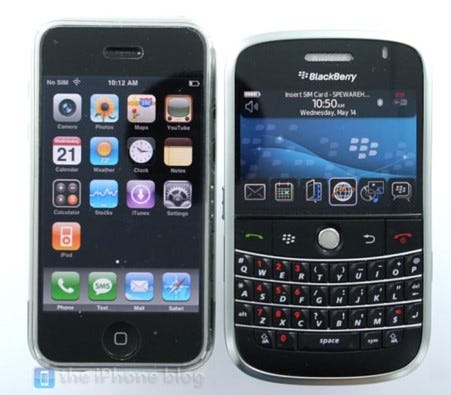
The iPhone managed to sell an extremely expensive tool — and by being so expensive, it became something to be taken seriously, immediately. The exclusivity of the iPhone is interesting because it changed priorities in a way we never reversed.
In general, computers have always been relatively expensive, and Apple has consistently positioned itself at the high end of the market. The company long resisted producing cheaper versions of its products — a strategy it has only softened in recent years — yet it has still managed to maintain that aura of premium quality.
That alone doesn’t explain everything, though. BlackBerry phones, in a sense, allowed users to carry a small, affordable version of their computers in their pockets — thanks especially to the QWERTY keyboard, which effectively resembled a computer keyboard in miniature — and popularised themselves by being reliable, geeky, and bold. As the 2023 movie depicts, the BlackBerry was fundamentally a prototype —or, better, an assembly – of something distinctly nerdy. It offered all sorts of technically sophisticated interfaces and features — encryption, secure messaging — which became legitimate markers of credibility and professional trust. The Obama presidency, for instance, was known for proudly endorsing and showcasing the BlackBerry.
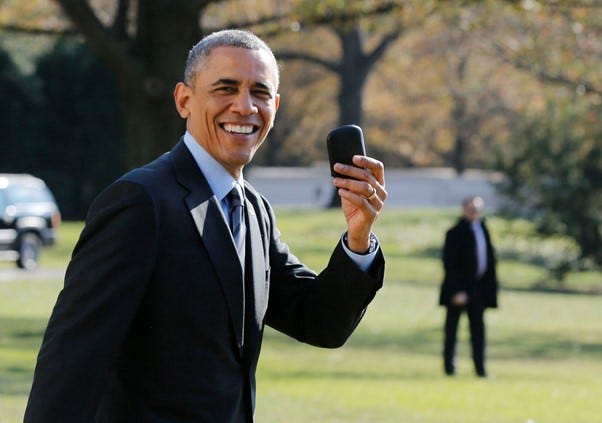
A delighted President Obama, who has just retrieved his phone after forgetting it in the Oval Office on November 21, 2014 – more play to come! (credit: Larry Downing—Reuters)
But what BlackBerrys truly embodied — especially if we think about the physical act of typing — was a prototype of a particular kind of engagement. The feeling of typing itself — rapid, thumb-based — became its own form of communication. As Michel Serres points out in his book Thumbelina, this thumb-based interaction marks a fundamental shift in how we relate to our devices and, perhaps, to knowledge itself.
The iPhone, by contrast, made that pocket computer premium by default — a kind of mobile Ferrari. Yet iPhones never attempted to offer a Ferrari for everyone. And while, in many ways, they are Ferraris compared to an old Nokia phone, Ferraris aren’t necessarily what everyone wants, even if they can afford one.
Different products exist for different needs and ranges; some offer similar experiences, while others emphasize entirely different performance metrics. So again, the price factor, I believe, was less about functionality and more about making a statement — a declaration of why the iPhone was premium, and therefore a statement of importance and endurance, implementing the toughest materials in the world in its making.
The question remains: why did the iPhone so systematically consume the entire market?
The Game Boy of the Future?
If BlackBerry, Nokia, and all those small, portable, plasticky yet edgy devices once represented something bold, rough, and even sexy in their design, they also carried the lingering aesthetic, which, for me, is fundamentally defined in the of the 1990s ultimate gimmick of the Nintendo Game Boy — that portable, tactile toy for the original generation of tech enthusiasts. Those early adopters —the so-called pushback nerds who later could afford both the BlackBerry and, eventually, the iPhone —knew this lineage well; they had grown up with it.
This connection is even hinted at in BlackBerry, when the founders present their early prototype — a “mobile linking tool” assembled from the various electronic parts they had at hand. The scene captures something essential: a kind of tinkering spirit, playful yet ambitious, that tied back to the culture of hands-on, game-inspired experimentation.
This traces back to the unmistakable excitement Nokia phones generated with the game Snake—still promoted today as a top reason to buy a Nokia device. The Nokia with Snake was the ultimate “toy” phone, packed with playful offline features you could interact with for hours. Its simple, entertaining design made it highly convincing as a fun, engaging device.
What Steve Jobs did with the iPhone launch was, in many ways, the opposite. His device wasn’t simply for listening to music or casual engagement — it was positioned as sleek, expensive, and professional. In doing so, Jobs made every device that didn’t look like an iPhone suddenly appear outdated, even toy-like.
The iPhone didn’t just offer hyperconnectivity or coolness; it redefined the entire aesthetic of technology. It made “pro” the new default. It made every user feel as though they had grown up — stepping out of the toy era and into the new, shiny reality of adulthood.
This is what set the foundation for all later phones, including those from Samsung and many other manufacturers; they follow the iPhone’s foundation. iPhones suddenly became something more serious than a mobile Game Boy that connects and lets you talk to your friends. You can take out your Game Boy in the middle of a professional meeting, but now you’re doing something professional and cool. Thus, perhaps here is the riddle solved of why iPhones became the fundamental tool for professionalism, photography, and everyday interactions. They became a status symbol that made all other technologies before it seem a throwback to some retro, nerdy establishment that all these professionals had never grown out of. The iPhones were the future because they set a new standard for what the future needs to look like. Smartphones, taken seriously — at least, this is what the BlackBerry film tried to imply, or at least give me the impression of.
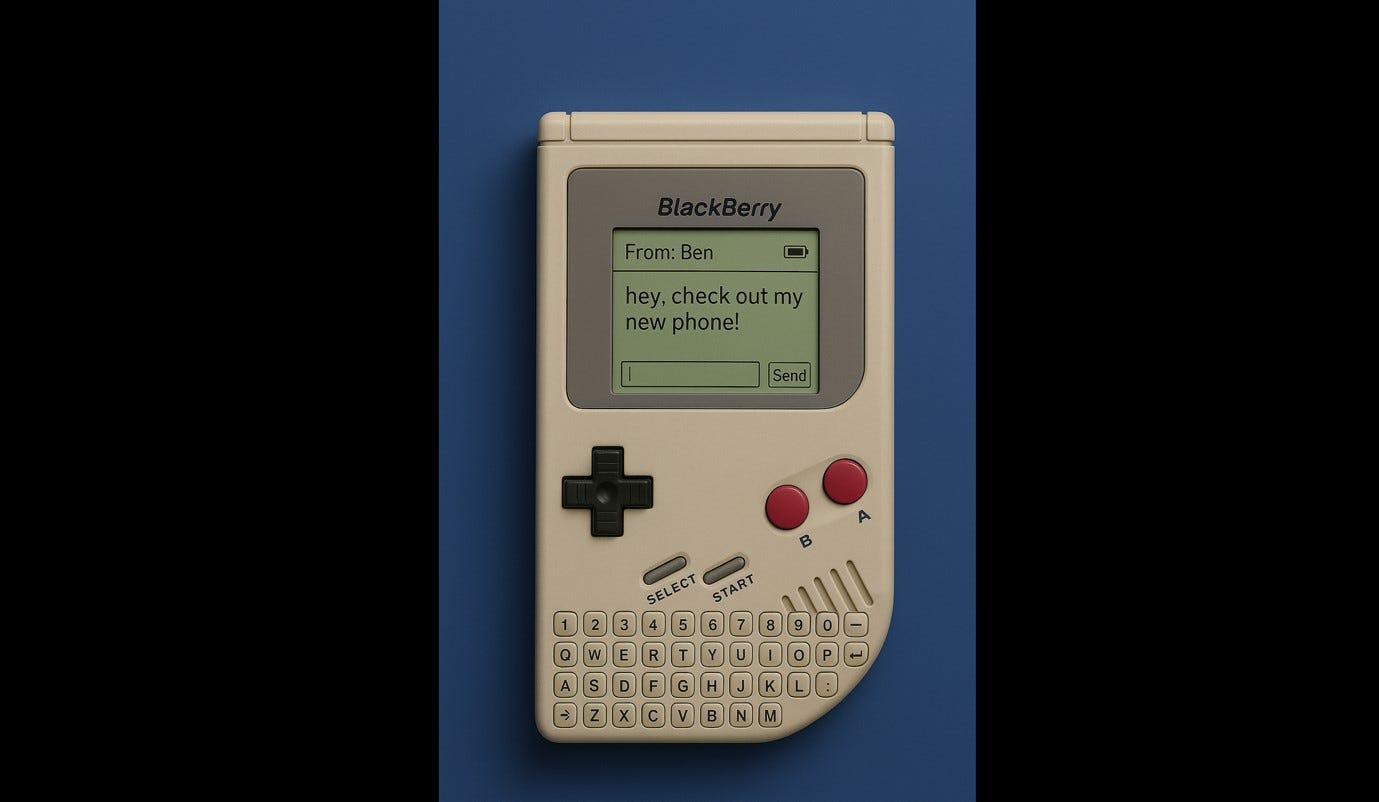
A merger of a BlackBerry with a Game Boy (Credit: Chad)
Sexy Toys
Nevertheless, what we encounter is something quite different when we think about what these tools eventually became. Once they hit the market — the iPhone in particular — it’s clear, as the film BlackBerry subtly suggests (and as I’ve intuitively considered myself), that the iPhone replaced the BlackBerry by being, quite simply, a sexier toy. Its appeal lay not only in functionality but in feel — in its sleekness, desirability, and status as an object of aspiration. This notion of “sexiness” as a design philosophy is something that Tesla, quite evidently, has also attempted to embody — look at the naming of its models: S, 3, X, Y. And while Elon Musk’s marketing carries a certain machismo, the iPhone itself is by no means a masculine tool; its appeal is universal — across genders and identities alike.
What’s particularly fascinating is how this —the iPhone “toy,” because it was still, in many ways, a toy—came to symbolize something much larger. With its full screen, it evoked a kind of Kubrickian monolith of knowledge (a comparison others have made before). But what it truly accomplished was not just to make professionalism sleek and expensive; it redefined play itself. Through pinching, swiping, scrubbing, and tilting, the iPhone made the haptic physicality of playfulness endless. It could do everything, with all sorts of gimmicks and fantastical responses that were just the baseline of pure entertainment, masked as top-notch efficiency and professionalism.
The haptic element of physical feedback — the pleasure of touching the device — evolved into a visual experience that absorbed the user and enabled them to do much, much more. This shift was already visible in Apple’s early focus on the Retina display: the screen itself became the core of interaction, the very surface through which touch transformed into vision.
In doing so, it effectively returned to the spirit of the original Game Boy — now in full-screen form. The Game Boy, after all, had no keyboard, only a few simple buttons, much like the early iPods. The iPhone inherited that lineage, following astonishingly even the same philosophy which Nintendo has long been criticised for, being technologically drawn back compared to its competitors, offering, at least in the early models, minimal to no colours variation and options to users – as a backlight – only to slowly become a slimmer device (as with iPhone Air just released), which a consistent fan-base they could satisfy with, really, anything. The iPhone had become, quite simply, the sexiest and most expensive Game Phone of them all – and one to rule them all.
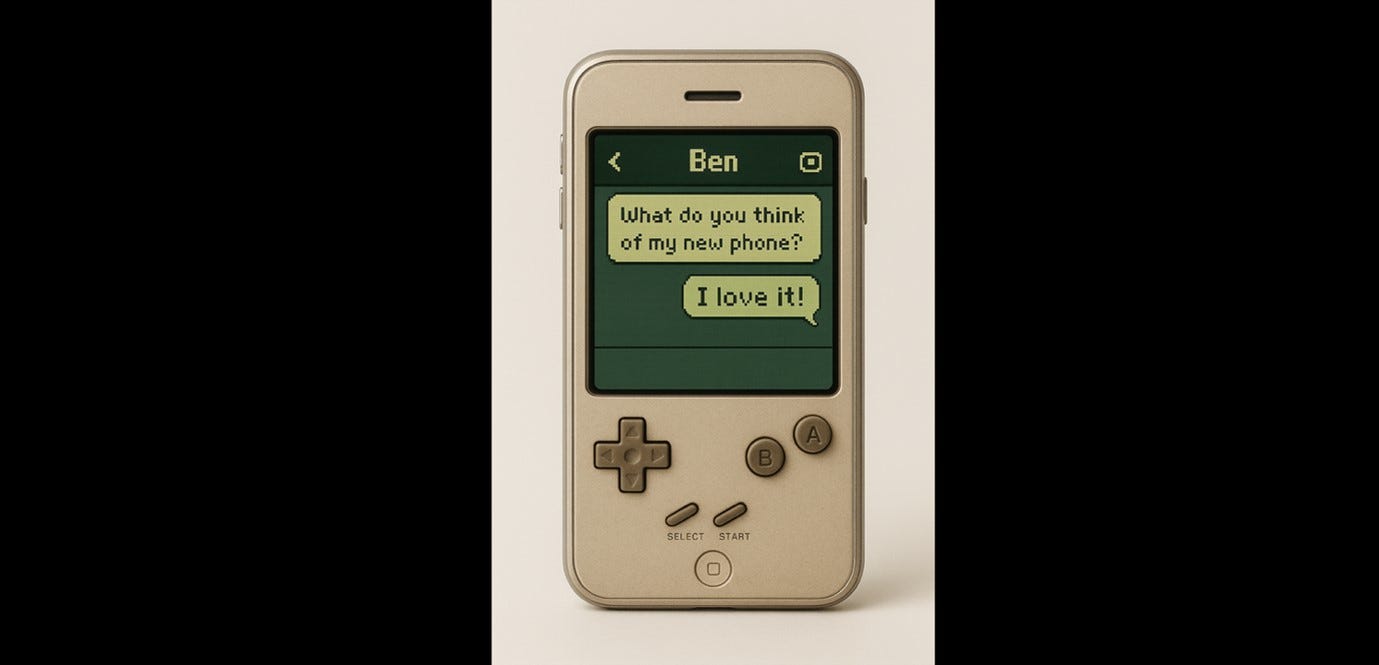
A merger of an early iPhone with a GameBoy (Credit: Chad)
Final notes on the (absorbing) future
A final consideration might be given to what the future of devices may look like. Entrepreneurs such as Mark Zuckerberg have promoted AR and VR glasses as potential replacements for smartphones, yet they still don’t feel entirely convincing. Another possible route lies in chip-based wearables — technologies that become embedded within everyday, hyper-connected systems. These might range from Neuralink-style implants to tiny devices placed directly in or on the body.
But this assumes that users want to be fully embedded — internally connected to their devices. My argument, suggested earlier, is that people are often drawn to technologies that can be seen. Concealing technology inside the body doesn’t satisfy that social and aesthetic impulse. We like to show our tools and hold them. We want devices that are fun to hold, that look good, and that we can be seen using. The gadget remains an extension of self-expression — an object that must be engaging for the user and interesting to others, not just a toy that adults never grow out of.
So perhaps the next compelling device will be both playful and useful: physical, adaptive, and alive with personality — a kind of mobile companion. Think of it as like the daemons in Philip Pullman’s novels: externalized aspects of self that shift shape according to mood and context. Such a device, powered by AI, could oscillate between sleek professionalism and joyful play, adapting to different settings and emotional needs.
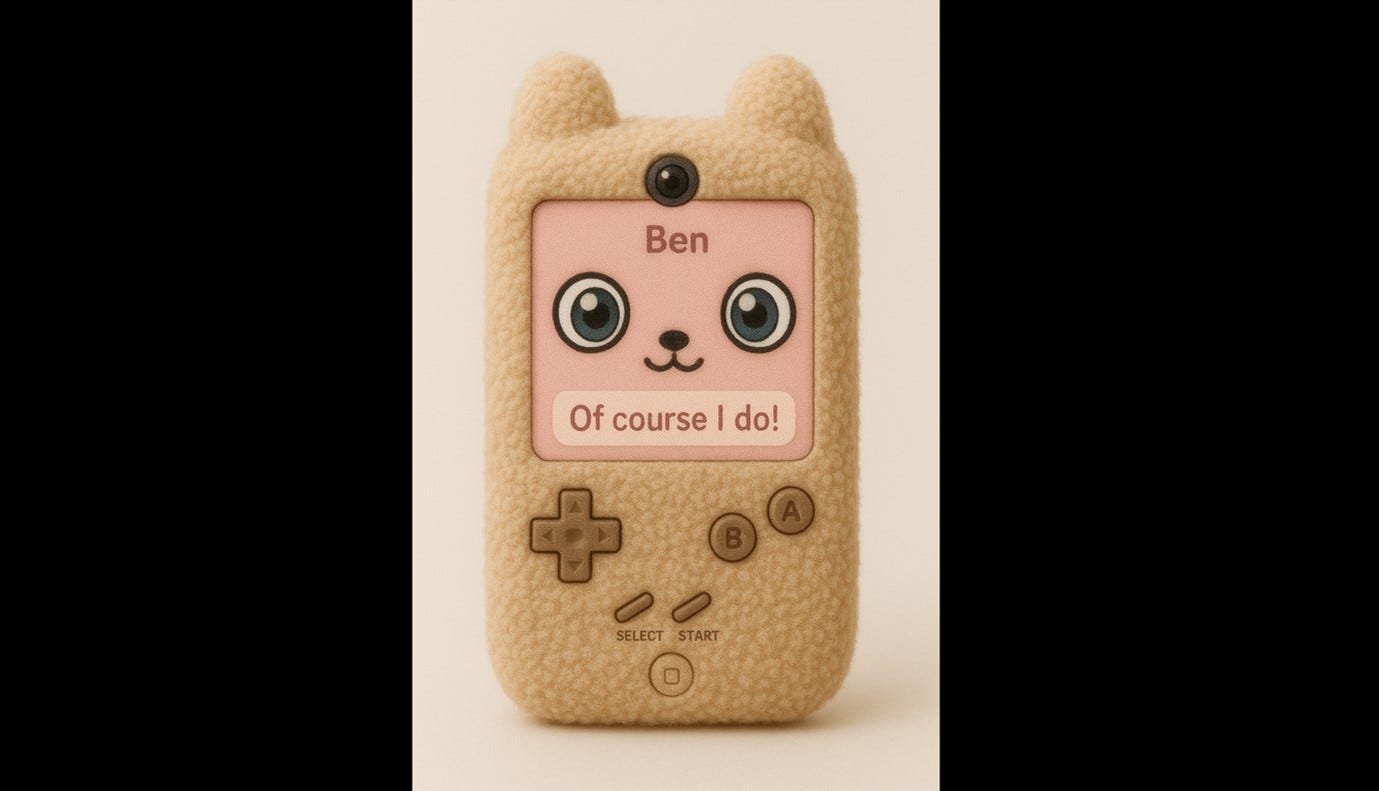
Merging the early iPhone with a Game Boy in Labubu style… (Credit: Chad)
In Donna Haraway’s terms, this would be the ultimate oddkin — a close technological companion that participates in a “cybersymbiosis” between humans and other-than-human beings (Haraway, 2016, p. 4). A being of soft intelligence and charm, designed to meet our deep desire for connection, play, and attention — the same impulses that make us adore cute, collectible gadgets like the Labubu figures currently driving global hype. These devices redefine what it means for a gadget to be “cool” — playful yet dignified, and inclusive across genders and ages.
In this sense, the next technological revolution might merge the early iPhone with the Game Boy — in the style of Labubu meets the Tamagochi: tactile, expressive, and alive with attitude. This isn’t entirely new; hybrid organic–digital interactions have long been imagined. But they point toward a deeper future of cyber-symbiosis — one that may become our primary mode of device engagement.
Unlike Byung-Chul Han’s notion of “non-things,” these hybrids wouldn’t disappear into the ether. Instead, they would become the real things — embodied interfaces shaping how we relate, play, and connect[1]. Not just disembodied voices like in Her, but intelligent companions that are embedded and embodied — prosthetic extensions of our subconscious needs for entertainment, comfort, and company, physically filling the social and emotional voids around us.

Still from the anime Macross Frontier, where the users would interact with the tool by squeezing and talking to it, was released months after the iPhone announcement.
And finally, so, the last monstrous merge we might expect – sometime soon?
[1] An interesting anime depicting a tool that would ‘eat’ data, embody earphones and display a screen over its organic body was explored in the anime Macross Frontier – thanks Daniel Gati for pointing it out.